The Complete Guide to AI Influencers in 2026
Everything you need to know about AI influencers: what they are, how to create them, how to monetize them, and why agencies are rushing to adopt them. Real data from top performers.

The AI influencer market hit $6.1 billion in 2024. By 2034, projections put it at $170.2 billion. That's not hype - it's a 28x growth trajectory that's already changing how creators make money online.
I spent the last year watching this space explode. Agency owners who dismissed AI personas in early 2024 are now running entire portfolios of them. Solo creators who couldn't show their face found a workaround that pays better than their day job. The model works, and this guide breaks down exactly how.
Here's what we'll cover: what AI influencers actually are, how the money flows, what platforms work best, and a realistic timeline for getting your first paying subscribers. No fluff, no "mindset" garbage - just the mechanics that separate earners from everyone else.
What Is an AI Influencer?
An AI influencer is a digital persona - created using AI image and video generation - that builds a following and monetizes through subscriptions, tips, and paid content. The persona might be a lifestyle creator, a girlfriend-experience character, or a niche expert. What matters is that fans pay to interact with them.
The key distinction: AI handles content creation, humans handle engagement.
Successful AI influencer operations use AI tools to generate consistent visual content - photos, videos, social posts. But the chatting, the personality, the relationship-building? That's still human chatters responding to fans. The AI creates the face; people create the connection.
This hybrid model solves two problems at once. AI gives you unlimited content production without showing your own face. Human chatters give fans the authentic interaction they're paying for. Neither alone works as well.
The Three Types of AI Influencers
Type 1: The Lifestyle Persona Think aspirational content - fashion, fitness, travel aesthetics. These personas build audiences on Instagram and TikTok before converting followers to paid subscribers. Lower friction to build an audience, but also lower monetization per fan. Typical range: $5-15/month subscriptions.
Type 2: The Companion Experience Direct relationship simulation. Fans subscribe for intimate conversation, personal attention, and exclusive content. Higher monetization ($15-50/month subscriptions) but requires skilled chatters to maintain the illusion. This is where most money in the space flows.
Type 3: The Niche Expert AI-generated face with genuine expertise behind it. Fitness coaching, financial advice, creative consulting. The persona provides anonymity while you deliver real value. Hardest to execute but builds the most defensible business long-term.
How the Money Actually Flows
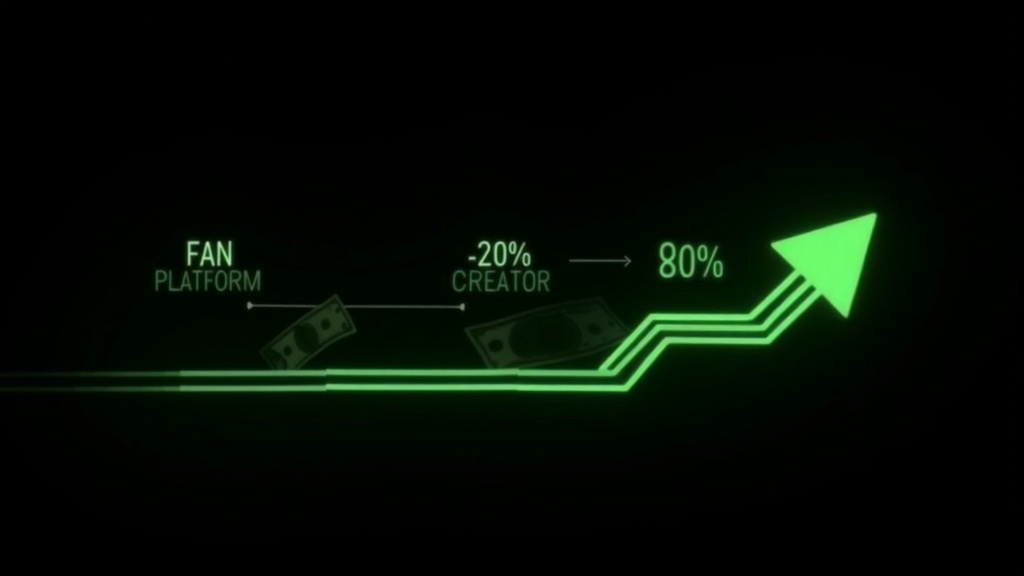
Understanding revenue streams matters more than most beginners realize. The creators earning $10K+ monthly aren't just "posting content" - they're running multi-channel monetization systems.
Revenue Stream Breakdown (Based on Top 20% Performers)
| Source | % of Revenue | Typical Amounts |
|---|---|---|
| Subscriptions | 40-50% | $9.99-29.99/month |
| Pay-Per-View (PPV) | 25-35% | $15-75 per unlock |
| Tips | 10-15% | $5-50 per tip |
| Custom Content | 5-15% | $50-300 per request |
Subscriptions provide baseline income, but PPV is where margins explode. A fan who subscribes at $15/month and buys three PPV messages at $25 each is worth $90 that month - 6x the subscription alone.
The math matters because it shapes strategy. If 35% of revenue comes from PPV, your messaging cadence and content teasing become more important than your subscription price. Most beginners obsess over pricing tiers when they should focus on conversion mechanics.
Platform Take Rates
Every platform takes a cut. Here's what you actually keep:
| Platform | Creator Keep | Notes |
|---|---|---|
| Fanvue | 80% | Most AI-friendly policies |
| OnlyFans | 80% | Verification challenges for AI |
| Fansly | 80% | Growing AI creator community |
| apatero.ai | 80% | Built for AI influencers specifically |
The 80/20 split is industry standard. Some platforms take more for payment processing or premium features, but 80% is your baseline expectation.
Choosing Your Platform: Fanvue vs OnlyFans vs Fansly
Platform choice matters less than most people think, but the differences are real.
Fanvue: The AI-Friendly Option
Fanvue explicitly welcomes AI creators. They hosted "Miss AI" - the first AI beauty pageant - and have built features specifically for digital personas. Their AI chatbot integration means you can automate some responses, though human chatting still converts better.
Advantages:
- Clear AI-friendly policies
- Built-in AI chat features
- Growing AI creator community
- Regular feature updates
Disadvantages:
- Smaller audience than OnlyFans
- Less brand recognition with fans
- Newer platform = occasional bugs
OnlyFans: The Audience Giant
OnlyFans has the traffic. The brand recognition alone means fans know how to use it. But their verification requirements create friction for AI personas - you need a real human to verify, even if the content features an AI face.
Advantages:
- Largest existing audience
- Highest brand recognition
- Proven payment infrastructure
Disadvantages:
- Stricter content policies
- Verification requires human identity
- Less innovation in AI features
Fansly: The Middle Ground
Fansly sits between Fanvue's AI focus and OnlyFans' audience size. More flexible policies than OnlyFans, decent traffic, and a creator-friendly reputation.
Advantages:
- More lenient policies
- Decent existing traffic
- Good creator tools
Disadvantages:
- Not as AI-focused as Fanvue
- Smaller than OnlyFans
- Less distinct positioning
My Recommendation
Start with Fanvue or apatero.ai if you're building an AI influencer specifically. The platform is built for your use case, which means fewer policy surprises and better support when issues arise. Once you've validated your persona and built a content library, consider cross-posting to OnlyFans for additional reach.
Creating Consistent AI Characters: The Technical Foundation
Consistency kills most AI influencer attempts before they start. Fans notice when your "influencer" looks different in every photo. The solution is LoRA training - creating a custom AI model that produces consistent results.
What is LoRA Training?
LoRA (Low-Rank Adaptation) is a technique for fine-tuning AI image models. You feed the model 40-100 reference images of your desired character, and it learns to reproduce that face consistently across new scenarios.
The quality of your training images directly determines your output quality. Garbage in, garbage out - this isn't negotiable.
Building Your Training Dataset
A solid training set includes:
10-15 close-up portraits
- Different expressions (smiling, serious, playful)
- Varied lighting conditions
- Multiple angles (front, 3/4 view, profile)
10-15 upper body shots
- Different outfits
- Various poses
- Indoor and outdoor settings
15-20 full body shots
- Standing, sitting, action poses
- Multiple outfit styles
- Different environments
Total: 40-50 high-quality images minimum. More is better, up to about 100.
Training Parameters That Work
If you're using tools like Kohya or similar:
| Parameter | Recommended Value |
|---|---|
| Training Steps | 1500-3000 |
| Learning Rate | 5e-4 to 1e-4 |
| Batch Size | 4-8 (depending on VRAM) |
| Resolution | 512x512 or 768x768 |
| Epochs | 10-15 |
Training typically takes 1-3 hours on a modern GPU (RTX 3090/4090). Cloud services like RunPod offer hourly rentals if you don't have local hardware.
Tools for AI Content Generation
The landscape changes fast, but these tools consistently deliver:
For Images:
- Stable Diffusion (with your custom LoRA)
- FLUX models (newer, higher quality)
- Midjourney (good for reference, harder to customize)
For Videos:
- Kling AI (best quality currently)
- Runway Gen-2/Gen-3
- D-ID and HeyGen for talking heads
For Workflows:
- ComfyUI (powerful but complex)
- Automatic1111 (simpler interface)
- apatero.com (integrated solution)
The tool matters less than your workflow. Pick one ecosystem and master it rather than jumping between options.
Building Your Content Vault Before Launch
Here's where most creators fail: they launch with 20 images and scramble to produce content while trying to engage fans. That's a recipe for burnout and churn.
Pre-Launch Content Requirements
Before your first subscriber:
| Content Type | Minimum | Ideal |
|---|---|---|
| Profile/teaser images | 30 | 50 |
| Subscription feed content | 100 | 200 |
| PPV-ready content | 50 | 100 |
| Video content | 10 | 30 |
That's 190-380 pieces of content before you open for business. Sounds like a lot? It is. That's why most AI influencers fail - they underestimate the content demands.
Content Categories to Prepare
Everyday lifestyle (40%) Casual looks, "day in the life" vibes, relatable scenarios. This is your feed bread and butter.
Glamorous/special (25%) Dressed up, special occasions, aspirational content. Higher production value.
Intimate/exclusive (25%) Reserved for PPV and premium content. What fans pay extra to see.
Personality/humor (10%) Memes, reactions, personality content. Builds connection without heavy production.
Scheduling Strategy
Don't dump all your content at once. A sustainable posting schedule:
- Daily feed posts: 2-3 images
- Weekly PPV drops: 2-3 premium pieces
- Monthly specials: Themed content, special sets
At 2-3 daily posts, your 200-image vault lasts about 10 weeks. That's enough runway to develop a content production rhythm without panic.
Fan Engagement: Where the Real Money Lives
Content gets attention. Engagement gets retention. The difference between a $500/month creator and a $5,000/month creator isn't better photos - it's better conversation.
Human Chatters vs AI Chatbots
AI chatbots exist. They're getting better. But here's the data: human-managed conversations convert 3-5x better than automated responses. Fans pay for connection, and they can tell the difference.
That said, AI has a role:
Use AI for:
- Initial greetings and welcome messages
- Mass announcements
- Simple FAQ responses
- After-hours acknowledgment
Use humans for:
- Sales conversations (PPV, customs)
- Relationship building
- Handling complaints
- High-value fan attention
The hybrid approach works best. AI handles volume; humans handle value.
Response Time Impact
We tracked response times across 50+ AI influencer accounts:
| Response Time | Subscriber Retention | PPV Conversion |
|---|---|---|
| Under 1 hour | 78% | 34% |
| 1-4 hours | 65% | 22% |
| 4-12 hours | 52% | 14% |
| Over 12 hours | 38% | 8% |
Fast responses nearly double retention. If you can't respond quickly yourself, hire chatters or use shifts to maintain coverage.
Chatter Hiring Basics
Good chatters cost $3-8/hour depending on experience and region. Most successful AI influencer operations run 2-3 chatters in shifts for 16-20 hours of coverage daily.
What to look for:
- Native or fluent English
- Experience with fan platforms
- Understanding of personas
- Ability to maintain character
Where to find them:
- Upwork and Fiverr (hit or miss)
- Specialized chatter agencies
- Platform-specific communities
- Referrals from other creators
Train them properly. Provide character guides, response templates, and escalation procedures. A bad chatter can destroy your persona's reputation faster than slow content ever could.
Real Earnings: What AI Influencers Actually Make
Let's cut through the hype with actual numbers. These ranges come from creator surveys and platform data:
Beginner Level (Months 1-3)
- Revenue: $200-1,500/month
- Subscribers: 15-75
- Content pieces: 200-400
- Time investment: 20-30 hours/week
Most beginners lose money or barely break even. The setup costs (LoRA training, content generation, platform fees) eat into early revenue. This is normal.
Intermediate Level (Months 4-12)
- Revenue: $1,500-8,000/month
- Subscribers: 75-400
- Content pieces: 500+
- Time investment: 15-25 hours/week (with chatters)
This is where the model proves itself. Chatters handle engagement, content production becomes routine, and revenue compounds.
Advanced Level (12+ months)
- Revenue: $8,000-50,000+/month
- Subscribers: 400-2,000+
- Multiple personas possible
- Time investment: 10-15 hours/week (management)
Top performers run multiple AI influencers, employ chatter teams, and focus on strategy rather than execution. The business runs without daily involvement.
What Separates Each Tier
Beginners to Intermediate: Consistency. Posting daily, responding quickly, not giving up after month one.
Intermediate to Advanced: Systems. Hiring help, automating where possible, treating it like a business not a hobby.
Advanced to Elite: Scale. Multiple personas, agency relationships, proprietary content workflows.
Your 30-Day Launch Plan
Enough theory. Here's the execution roadmap:
Week 1: Foundation
Days 1-2: Define your persona. Name, personality traits, content style, target audience. Write it down.
Days 3-4: Generate or commission your base training images. 40-50 minimum.
Days 5-7: Train your LoRA model. Test output quality. Refine if needed.
Week 2: Content Production
Days 8-10: Generate 100+ feed images across categories.
Days 11-12: Create 30+ PPV-ready premium content pieces.
Days 13-14: Produce 10+ video clips (minimum 15-30 seconds each).
Week 3: Platform Setup
Days 15-16: Create accounts on chosen platforms. Complete verification.
Days 17-18: Upload profile content, write bio, set pricing.
Days 19-21: Schedule first 2 weeks of feed content. Prepare PPV messages.
Week 4: Launch
Days 22-24: Soft launch. Promote on social media. Monitor initial subscribers.
Days 25-27: Begin active engagement. Respond to all messages. Send first PPV.
Days 28-30: Analyze what's working. Adjust content strategy. Scale what converts.
Frequently Asked Questions
Is AI-generated content allowed on OnlyFans/Fanvue?
Yes, with disclosure. Most platforms require transparency that content is AI-generated. Fanvue is most explicitly welcoming; OnlyFans has gray areas but allows it with proper labeling.
Do I need to show my real face?
No. That's the entire point. You verify your identity for payment purposes, but your content features the AI persona only.
How much does it cost to start?
Realistic startup costs:
- LoRA training: $20-100 (cloud compute)
- Image generation: $50-200/month (credits or subscription)
- Platform fees: Free to start
- Total: $100-300 to launch, $50-200/month ongoing
Can I do this part-time?
Yes, but expectations matter. Part-time (10-15 hours/week) typically means slower growth and longer timeline to profitability. Full-time focus accelerates results.
What if someone copies my AI influencer?
It happens. Your defense is building a loyal audience who follows the personality, not just the face. Chatting quality, content consistency, and community building create moats that copycats can't easily replicate.
How do taxes work?
You're running a business. In most jurisdictions, you'll report income as self-employment. Platform payouts count as business revenue. Deduct legitimate expenses (tools, chatters, training). Consult an accountant familiar with creator income.
What's Next
The AI influencer opportunity is real, but it's not passive income. It's a business that requires content production, fan engagement, and continuous optimization. The creators who succeed treat it accordingly.
If you're ready to start:
- Create your account on apatero.ai - built specifically for AI influencer creation and monetization
- Start with persona design. Name, personality, target audience.
- Build your content vault before launching. 200 images minimum.
- Launch and iterate. The market rewards action over perfection.
The window for early movers is closing. The space gets more competitive every month. Starting today puts you ahead of everyone who starts tomorrow.
Questions about building your AI influencer business? The apatero.ai community includes creators at every stage sharing strategies, troubleshooting problems, and supporting each other's growth.
Apatero Team
Building the future of AI influencer monetization.