Business • July 17, 2026
AI Faceless YouTube: Animate Your Character, Not Your Face
Faceless YouTube is exploding but stock-clip channels are saturating. Use a locked AI character as the on-screen face and the niche reopens.
Read more →
Faceless YouTube is exploding but stock-clip channels are saturating. Use a locked AI character as the on-screen face and the niche reopens.

A general chatbot can make a great single image, but ask it for the same person again and you meet a stranger. Here is why saved identities beat prompt-and-pray, and when each tool is the right one to reach for.
One face, three completely different looks. Editorial, anime, comic. The style-LoRA-on-top trick that lets one character live in three universes.
Everyone obsesses over keeping the face consistent and then wonders why their AI influencer still looks like three different people. The body drifts too. Here is how to lock height, build, and proportions so the whole person stays the same across a feed.
Three ways to keep the same face across a hundred images, and they are not interchangeable. A trained LoRA, a reference-conditioned IPAdapter, and a hosted Soul each trade setup, control, and consistency differently. Here is how to choose.
Your persona held for forty images and then the face slid off. Here is a calm, ordered way to find what broke, starting with the cheapest fix and only escalating when you have to.
Leonardo is a broad, powerful creative suite. Apatero is built narrowly around one hard problem, keeping the same character across everything you make. Here is which one to reach for when a recurring persona is the whole point.
Stop re-uploading the same reference photo into every tool. A Soul saves your character once, server-side, and the Apatero MCP lets you drop that exact person into any new scene from a Claude conversation. Here is how the reuse loop actually works.
Most 78-card AI tarot decks die at card twelve. The lock-once, generate-everything workflow that ships a coherent deck in two days, plus the quality pass.
The LoRA-vs-IPAdapter decision tree, the page-by-page prompt template, and the rescue strategy for the inevitable page-eight drift in AI children's books.
The neutral model stare is what makes an AI persona feel dead. Here is how to prompt real smiles, laughs, and micro-expressions while the identity stays locked, so your feed reads as a person instead of a mannequin.
Civitai-LoRA workflow vs Apatero hosted persona lock. Setup cost, identity score, edit speed, ecosystem. The honest decision tree for solo creators.
The exact phrasing that swaps outfits in Flux Kontext while keeping the face and background locked. The one phrase that always breaks it, and the rescue.

Comic pages punish drift more than any other format. Six panels, one hero across all of them, and a workflow that scales to a forty-page issue.
Generic AI prints saturate Etsy. A locked character as a recurring star turns one-off prints into a collectible series buyers come back for.
Two characters in one frame is where most workflows collapse into identity soup. The regional-prompt-plus-dual-IPAdapter trick that holds both.

Build a complete AI character from one selfie, generate fifty post-ready images, ship a week of content in one afternoon. Real timing, real outputs.
LoRA alone caps near 85 percent identity match. Stack IPAdapter FaceID v2 on top and you cross 95. The exact node graph and the failures to avoid.

The IPAdapter weight that holds identity at portrait range breaks at full body. Here is the 100-image grid that shows the safe range per shot type.
Turn one selfie or render into a full turnaround sheet the AI can lock to. Front, three-quarter, side, back, plus expression strip. Real workflow.
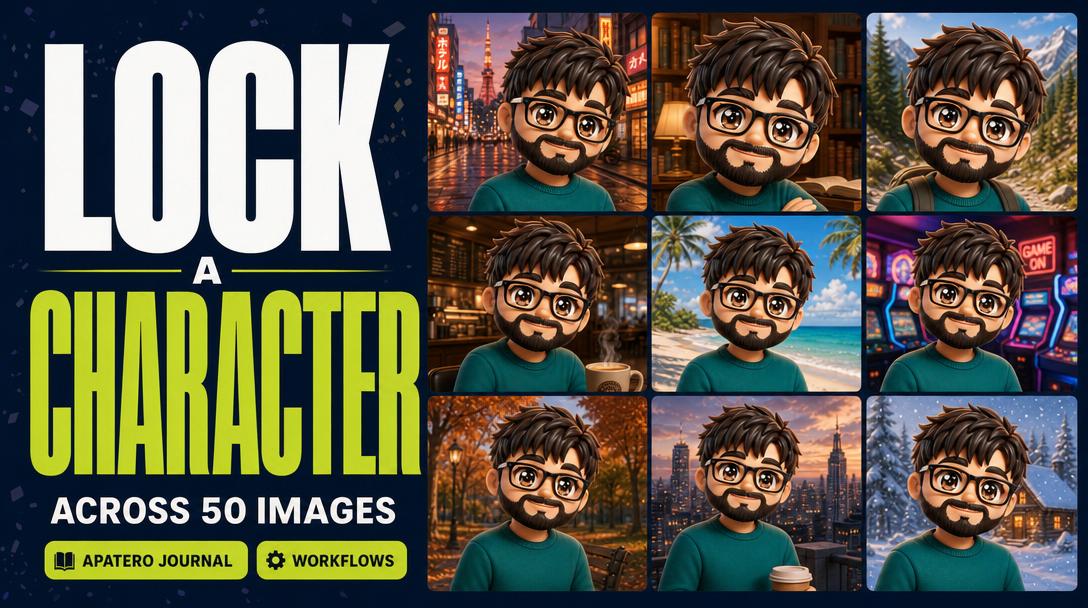
A real workflow for getting the same face, same outfit, same vibe across an entire image set. Without character drift, without re-prompting fifty times
Compare AI influencer generators by identity consistency, image and video workflow, editing control, ease of use, and public pricing transparency.